
HISTORY OF BAKER PERKINS IN ASIA
(See also History of Baker Perkins in South East Asia)
INDEX
- The Early Days
- The First Success
- Working with the Government Aid System
- A Huge Order for Tea Packaging Equipment
- An Insight into the Task of Selling Equipment to the Chinese
- Baker Perkins Group Sales by Region
- The Chinese Government create an Opportunity
- Completing the Paperwork
- Celebrating Success
- Setting up a Manufacturing and Assembly Operation in China
Joseph Allen Baker, by then Liberal member for Finsbury Park as well as chairman of Joseph Baker & Sons, travelled widely during WW1, supporting the Quaker ambulance units that were organised by his two sons. He visited France, Switzerland, Holland, Scandinavia, Greece and Russia. It was during a journey to Russia that, Augustus Muir records –
“He was asked privately by the Foreign Office to become a King’s Messenger and carry despatches – a task in which he was joined by his young colleague, Herbert Kirman. Both the business and the diplomatic missions were successful, but the Bolshevik revolution prevented the orders he had got for biscuit and chocolate machinery from being fulfilled”.
Another effort to obtain Russian orders was made in the 1920’s and Laurence King managed to sell a complete bakery plant worth £100,00. Muir tells us that –
“On his way home he was roughly handled by Russian officials who suspected him of being a spy. When his train stopped at a small station on the Polish frontier, his baggage was searched and a number of Baker Perkins drawings were closely scrutinised. None of his interrogators knew a word of English and they promptly locked him up. At the end of forty-eight hours, he was desperate and managed to escape, making a dash over several hundred yards of no-mans-land towards the Polish frontier post, with bullets whistling near him – hardly the farewell he expected from a country to which his firm was about to supply a bakery plant”.
Joseph Baker & Sons’ connections with China began just after World War One when Charles Baker became resident representative in Shanghai and was also successful in selling biscuit installations there. In 1968, the largest biscuit factory in the country, in Shanghai, was still operating with Baker Perkins equipment that had been installed in 1922.
The 1958 Annual Report mentioned that the Company had – “entered into agreements for the manufacture of certain equipment under licence in India”.
By 1965, Baker Perkins had a branch office – for the import of group products – in Bombay. This had been set up because of the difficulties experienced with Indian import regulations.
Working with the Government Aid System
In the post-WW2 years it was not unusual for Governments to disburse Aid to developing countries in the form of equipment to manufacture food. In 1966, the Australian Government, as part of the Colombo Plan of assistance to Asian countries, donated six complete bread bakeries to India for which Baker Perkins Australia Pty obtained the lion's share of the order - A$550,000 out of a total of A$850,000. Whilst the remainder of the equipment was divided among five other Australian bakery equipment manufacturers, Baker Perkins were responsible for all of the erection and commissioning of the six plants which were capable of producing a total of seven tons of bread per hour when erected in major cities throughout India.
Douglas Rownson Ltd supplied a £92,000 plant to Russia in 1968, as part of a new car factory. The order included equipment to mix oil with a special powder, heat the grease which the mixing produced to 200 degrees C, de-aerate and cool the grease before passing it to storage vessels.
In 1967, Canadian Baker Perkins had supplied all of the equipment for three new bakeries in India. But not all opportunities in this part of the world went through smoothly as John Peake – then president of Baker Perkins Inc – ruefully reported in his 1975 Annual Report –
“We have recently reassessed our short and long term plans ………….. this action has been precipitated because a very large bakery order for bakery machinery to be shipped to India has failed to materialize. The Canadian Government had already approved placing this order for approximately $3 ½ million with Baker Perkins as part of its foreign aid programme. However, at the final stage, the Indian Government rejected the project”.
A Huge Order for Tea Packaging Equipment
In 1980, Rose Forgrove won an order to supply tea-packing machinery to Russia. Worth £3m, this was the largest single order ever won by the company and Rose Forgrove’s negotiating team spent a very tough fortnight in Moscow before the deal was signed. This was not the first time that the company had supplied tea cartoning machines to Russia. Records show that Job Day (part of the Rose Forgrove sub-group), supplied 18 machines in 1907.
The breakthrough which eventually led to this order from the USSR, started three years previously, when Rose Forgrove sold a tea cartoning machine to Poland -the performance of the machine and the service back-up from the company impressing the Russians, their technicians spending some time visiting a number of Rose Forgrove installations and at company plants assessing its technical and productive capability.
Rose Forgrove signed a second contract with the Russians, again for £3m of Tea cartoning machinery, only sixth months later and a further contract within a year brought the total amount of business gained from V/O Technopromimport of Moscow to over £15m.
An Insight into the Task of Selling Equipment to the Chinese
In 1974, Peter Newton who up until then had been managing director of Baker Perkins Far East Ltd, provided an insight into the task of selling equipment to the Chinese –
“Baker Perkins Far East have been able to successfully negotiate an order with the Peoples Republic of China worth £750,000. The order covers ten Rose Forgrove lined cartoning machines, weighers and overwrappers for packing tea.
Business transactions really commenced in 1972 when Sir Ivor Baker, Jack Stanton and myself visited Kwongchung at the time of the bi-annual fair. At that time general discussions were held and we subsequently sold wrapping machines worth £50,000.
In the autumn of 1973, a delegation from the China National Products Corporation visited the Rose Forgrove factory and also a Brook Bond Tea packaging factory in England. In the summer of 1973 we commenced a detailed exchange of correspondence with the Chinese Machinery Import and Export Corporation and in October I went to Canton to continue the discussions. I was soon joined by Barry Gunton from Rose Forgrove in the UK.
After twelve days of discussions it was decided that further technicalities would have to be clarified in the UK by laboratory tests and Barry returned to Leeds to arrange this. Whilst I was on leave in Australia at Christmas an urgent call came from the Chinese Government inviting me to go to Peking to discuss the project further. The temperature was 12 degrees C below zero and the first thing that I did was buy a fur hat and gloves.
A visit to Er Li Ku in Peking, the headquarters of the Chinese National Machinery Corporation, was the start of fourteen days of hard negotiations and a constant flow of telexes between Peking, Hong Kong and Leeds. But eventually the order was finalised and signed. During negotiations, discussions were usually held from 9.30 to 11.30 am and occasionally in the afternoon, each day, including Saturday and Sunday. The Chinese work a six day week and on Sunday when the State requires.
The procedure commenced with the passing of pleasantries and copious cups of tea. Then, facing upwards of seven professional negotiators, the talks would begin. It was constantly brought to my attention that I was negotiating with the representatives of 800 million people whose word is, and has proved to be, as good as their bond”.
Baker Perkins Group Sales by Region
In 1982, the last year in which figures were split at this level, the sales by geographical area were as follows:
| United Kingdom | £26.587m |
19.3% |
| Rest of Europe | £29.170m |
21.2% |
| North America | £46.165m |
33.5% |
| Africa, India, Middle East | £15.981m |
11.6% |
| Australasia | £10.902m |
7.9% |
| Latin America | £6.654m |
4.8% |
| Far East | £2.343m |
1.7% |
£137.802m |
Baker Perkins BCS Ltd formed Baker Perkins Hong Kong Ltd in 1985 to meet the growing opportunity represented by the People’s Republic of China.
The Chinese Government creates an Opportunity
Despite the fact that bread was not a traditional Chinese food, the Chinese government were investing a colossal amount of money in flour milling, bread baking and noodle manufacture, partly because of their moves to reduce the traditional two-hour lunch break to one hour. The hope was that, by making bread available, workers would be encouraged to bring their lunch to work instead of going home to eat.
The Australian and New Zealand Baker Perkins companies carried out two-years of intensive marketing in China in anticipation of this change and were rewarded, in 1985, with four orders, each of around $A1m, for automatic bread plants. Ovens, provers, coolers and conveyors were manufactured in New Zealand and the unit machines in Australia. The plants were tailored specifically for the Chinese market, with an output at 3150 loaves per hour, being somewhat smaller than was usual for Australian equipment and lacking micro-processor control as the Chinese were, at that time, worried about servicing and cost.
Also in 1985, the British Food and Beverage Group was formed with the specific objective of encouraging links between China and the UK. Baker Perkins and United Biscuits were members and, in 1986, co-operated in a Trade Mission to China under the leadership of Earl Jellicoe. The visit co-incided with a visit to China by the Queen and Prince Philip and the opportunity arose for the mission, of which Mike Smith, managing director of Baker Perkins plc, was a member, to ‘borrow’ the Royal Yacht Britannia for a day to give a seminar to 60 senior Chinese visitors. The seminar recognised the need to improve the nutrition of Chinese babies, with the development of baby food being seen as a vital priority. United Biscuits had developed a infant rusk product in their laboratory in Maidenhead, that addressed the general iron deficiency in Chinese babies’ diet and Baker Perkins were able to supply the necessary process equipment. The hope was that this unprecedented services package of equipment, technology and formulation would persuade the Chinese to purchase a number of infant rusk plants.
Terry Nicholson, whose story is also told in History of Baker Perkins in South East Asia, recalls that in 1988,
"After 9 weeks of negotiations at the Negotiation Building in Beijing, with China’s Ministry of Commerce, buying agents CNTIC, and representatives from five user factories from different provinces, we secured a contract for £7.25million to supply five Infant Rusk Plants. During those nine weeks I was supported daily by the Peterborough team and by visits to the negotiation by Iain Davidson, my General Manager; by David Duffin, the Divisional Manager; and by Paul Parkinson, the MD of Baker Perkins. Of course they could go back home, or on to other business in Japan, Australia, or America. Me, I got to stay. Each of five separate contracts, each of 60 pages, and each in three copies, every one fully bound in heavy covers, took me a full day to countersign every page, and I narrowly avoided paying excess baggage charges on the flights back home”.
Derek Exton, a Service Engineer who started with Baker Perkins as an apprentice in 1947 commissioned a biscuit plant for a major Chinese customer in May 1998 and shares some photographic memories of the commissioning party.
Setting up a Manufacturing and Assembly Operation in China
This account deviates slightly from the timeline of the rest of this section as it describes an activity which took place a short time after the merger between APV and Baker Perkins in 1992. Its inclusion here is justified by its evocative description of the emotions experienced by someone plucked from their normal working environment to face the challenges inherent in building from scratch a business in a foreign country. The story is not without its humour a sense of which is arguably vital if one is to cope with the more "interesting" developments encountered on the road to sucess.
We are grateful to Phil Harnett - Project Manager APV Dalian 1994 to 1997 - for allowing us to share his experience.
- Introduction
- The Set Up
- The People
- Some personal memories
- The Nuclear 254 toilet story
- The story of the Pen and Pussy
- The Results
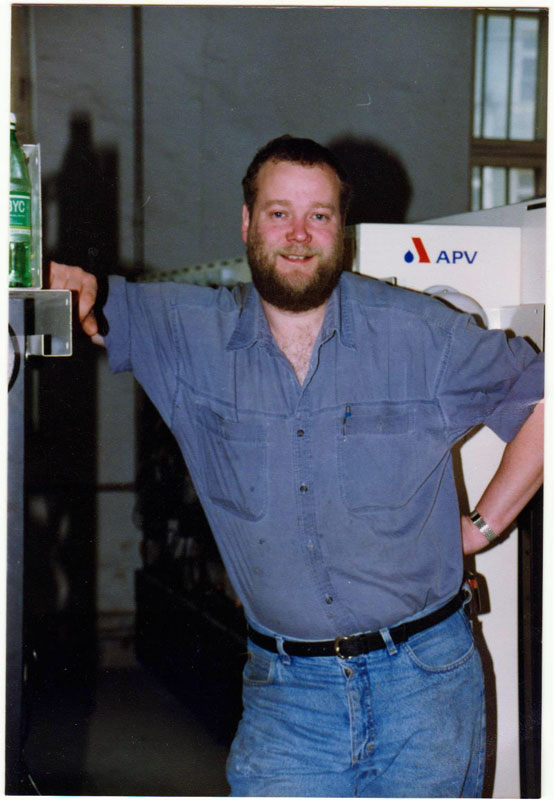 Having graduated in 1985, I joined the ranks of the old Westwood
works and enjoyed several varied positions as a graduate trainee in
Production Engineering, Production Control and HR. I remember well
having to work 36 hours one weekend for the move to the Paston site – trying
to get the removal guys to put all of the boxes in roughly the right
place.
Having graduated in 1985, I joined the ranks of the old Westwood
works and enjoyed several varied positions as a graduate trainee in
Production Engineering, Production Control and HR. I remember well
having to work 36 hours one weekend for the move to the Paston site – trying
to get the removal guys to put all of the boxes in roughly the right
place.
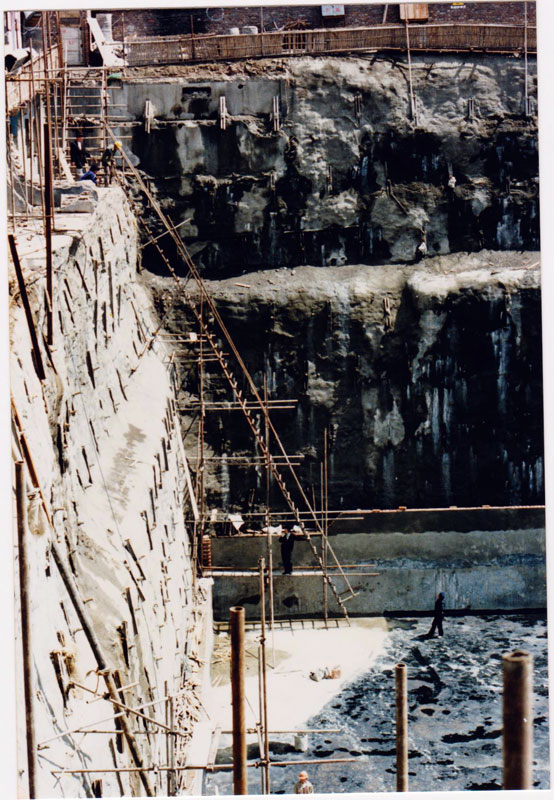
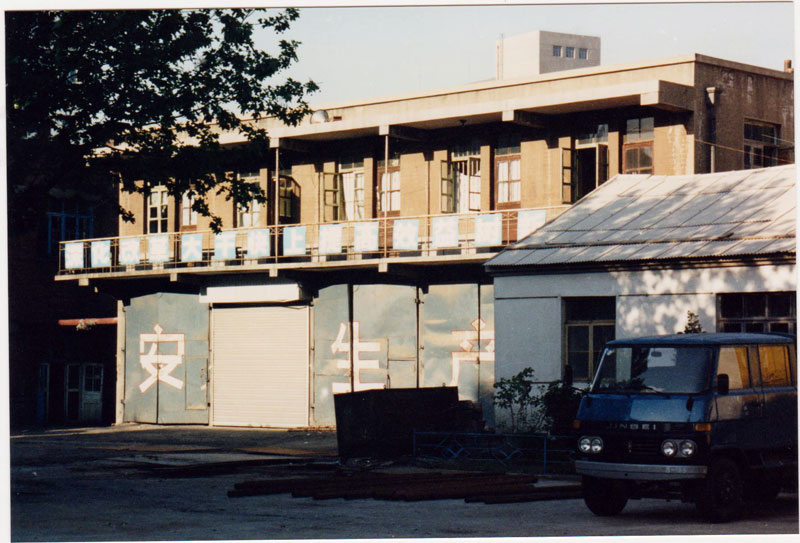
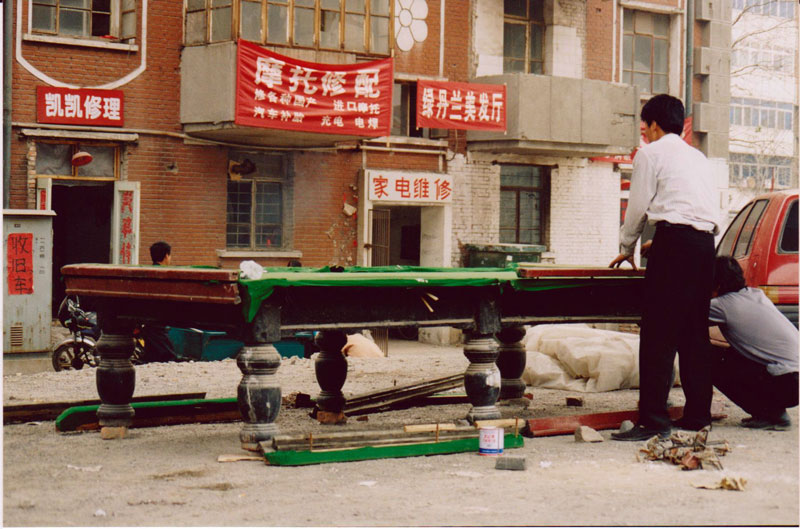
I had been the Production Manager at the Paston site for about 2 years when in 1992 I was asked to travel North to Bedewell. Working for Arthur Kanalas as GM, I soon had become well versed in the manufacturing techniques of the company’s Oven Range. Having just become - well sort of stable – it was with a little surprise that one day in October ’94 David Coles the Business Development Director came to visit and asked me to consider going to China to manage a new operation making Ovens for the Asian market. I jumped at the chance, and what follows is a recollection of the events, and a group of photos scanned in to make them available to you in digital format. Some of the photos may look a little grey … but that was true of much of China in 1994, and some may be a little poor in quality, as the film we could purchase in China was sometimes a copy and not good old Kodak. If only we had had digital cameras in 1994.
 |
 |
 |
 |
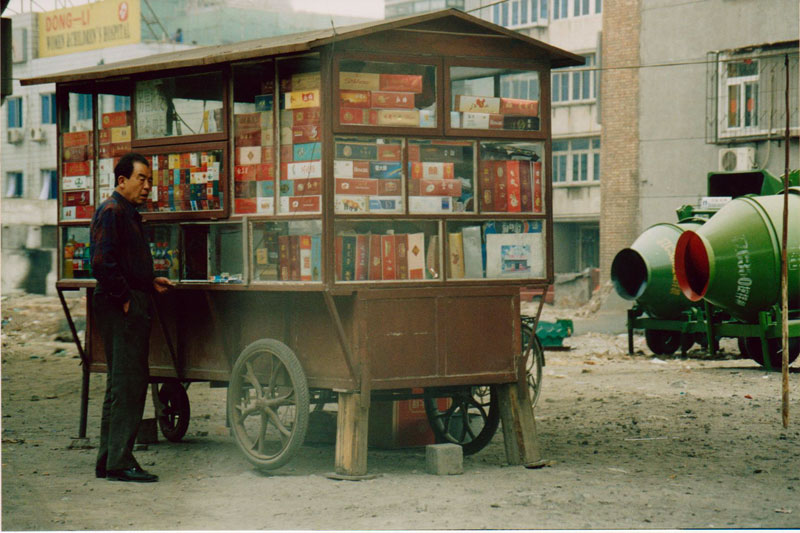 |
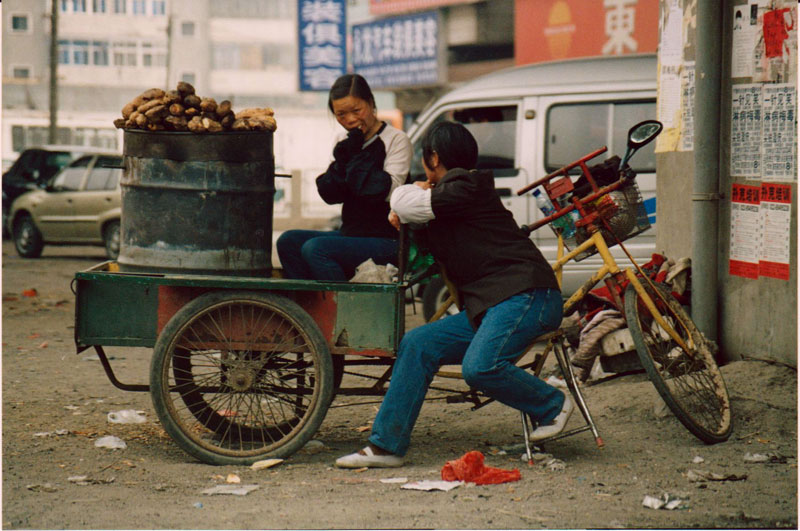
| Digging foundations by hand | Number 9 Factory accommodation | Anyone for a game of snooker? | Time for a snack |
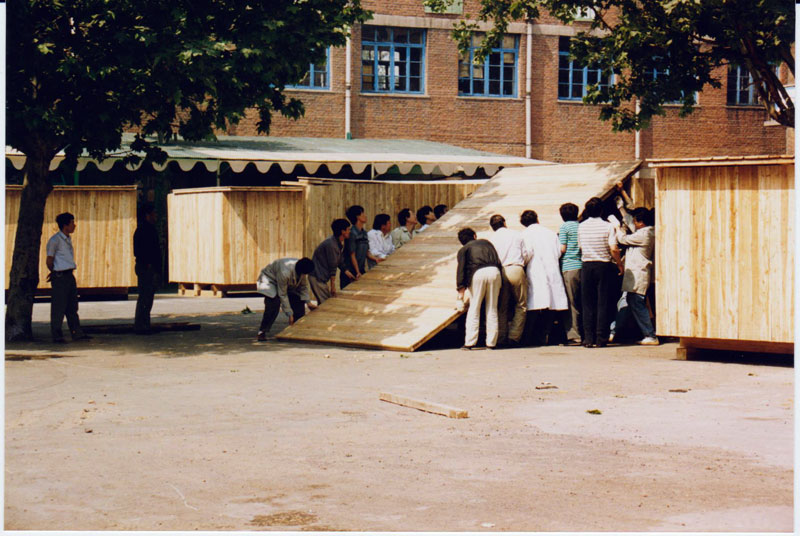
The task in hand was to set up a manufacturing and assembly operation to be capable of making Ovens in China for sale to Chinese or Asia customers. The early customers we to be established customers in England who were now setting up bakeries in Asia requiring the same processing capabilities but manufactured in Asia to save shipping costs.
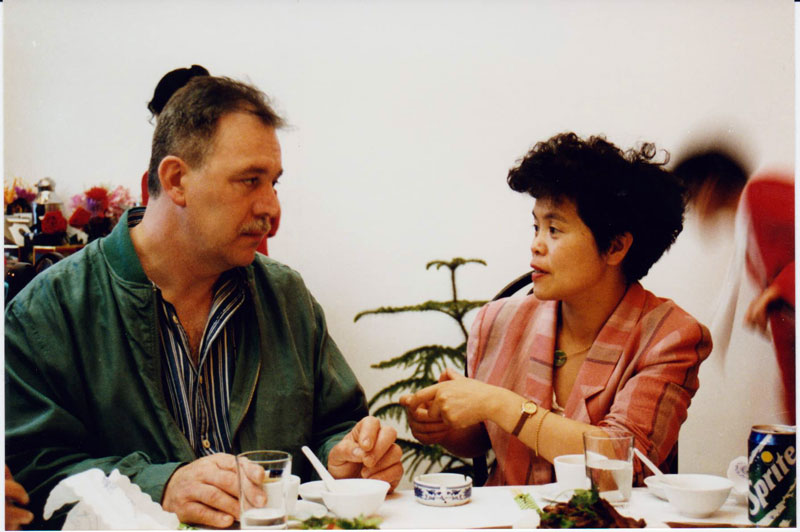
Initial contact had been made with the Liaoning Foreign Trade Company ( LFTC ) as in those days, all foreign companies had to trade through one of these Government organisations – to trade as an individual company was not permitted. Our main liaison lady was Li Han Bo, ably assisted by two wheeler dealers in Mr Chang and Mr Twee. I was to be assisted by a young graduate Phil Bewley, who whilst inexperienced more than made up for it with his incredible energy and willingness to take anything on that confronted him. As Phil was smaller in stature than I – we soon became known as Little Phil and Big Phil.
Early negotiations settled the main assembly factory to be the State controlled Radio Number 9 Factory. It was to become clear later than many of the factories that we dealt with had similar numerical names, an indication of how large the state industries had once been. One such example was the Nuclear 254 Factory, one can only guess… It was now required to find subcontractors to produce all of the parts required. Trips around the city of Dalian in the North East of China soon produced a range of suppliers that we thought in totality could produce the parts we required, but it was also evident that no one supplier could supply all of the parts. It was, therefore, decided that for expediency we would supply all of what we called “the shiny bits” from the UK. These included all of the electrics, motors, fans, door handles, rubber seals, bearings etc…. only the fabricated and machined parts were to be made in China.
Upon showing possible contractors drawings of our parts, several things came to light:
- Chinese engineers could not understand English – so all drawings had to be translated, this took many hours by the LFTC staff to hand write translations on to the paper drawings.
- Tolerance conventions were different to the West, so these had to be analysed and Chinese equivalents found.
- Raw material specifications in China were different, so again analysis and translation was required.
- Suppliers often had a limited range of machinery, so could only attempt a small range of the parts required, so “kits of parts” had to be formed by splitting the APV Baker Parts Lists structures down to form groups of similar parts. This entailed many hours of breaking down and summating the MRP system print outs to ensure sufficient quantities of each part were made.
Once these kits of parts were formatted, the huge piles of paper drawings were hawked around the potential sub-contractors for quotation and order placement. Delivery schedules were agreed and Purchase Orders placed. All of the parts to be supplied from the UK were purchased, placed in a container and sent on their way. If my planning worked out OK, just about everything would arrive at the Number 9 Factory at the same time and we could start the assembly.
Even looking through my photos, I am sorry to say that I cannot remember all of the people involved in the operation. Many only came for a few weeks to perform a specialist task, and some I do not have photos of as film was limited. To be fair I did not realise at the time how special the task in hand actually was. Here I list some of the main characters, and to all of others, please forgive me for not giving you a mention, you know we achieved something special and had some good times together.
 |
 |
 |
 |
 |
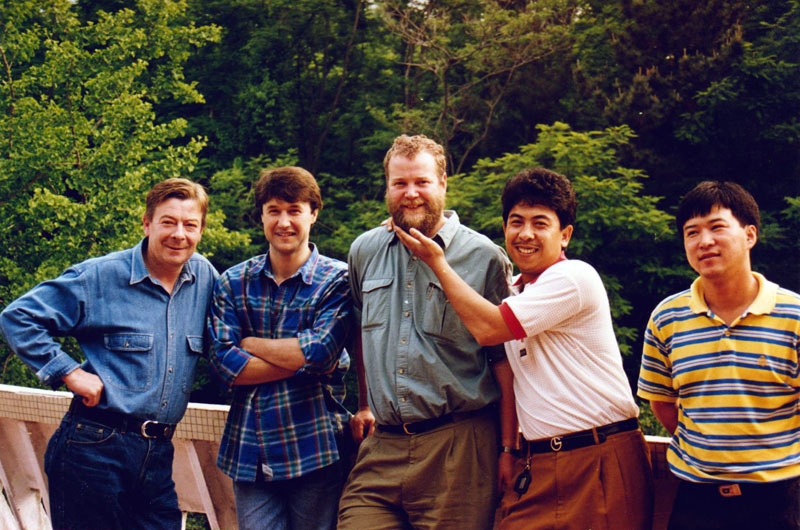 |
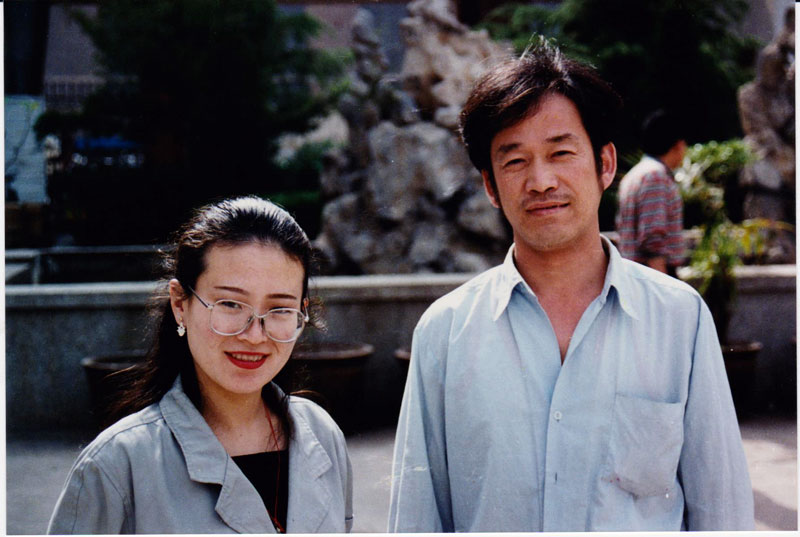
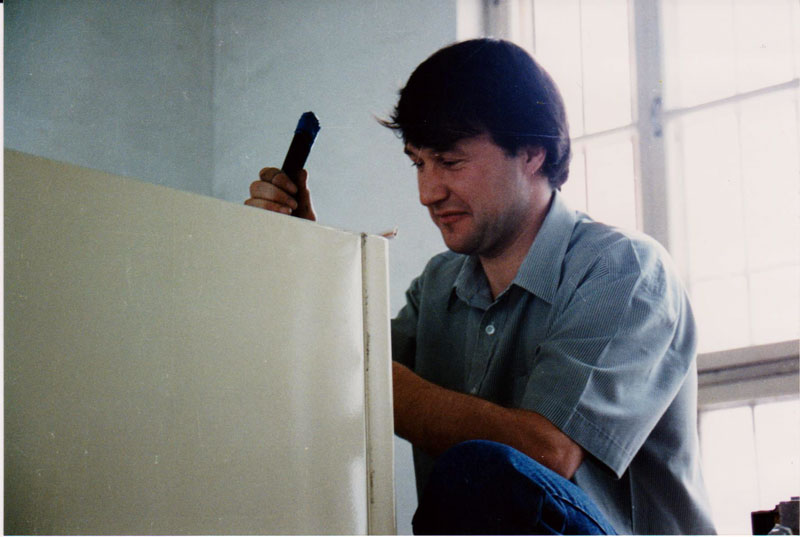
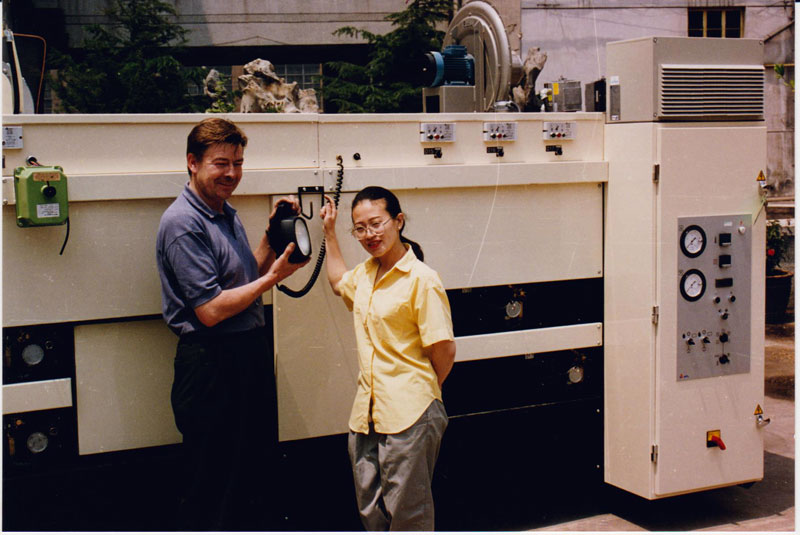
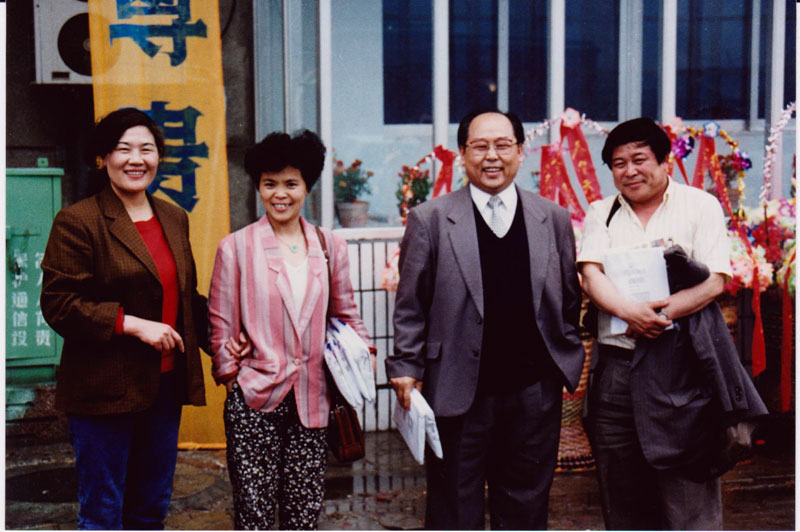
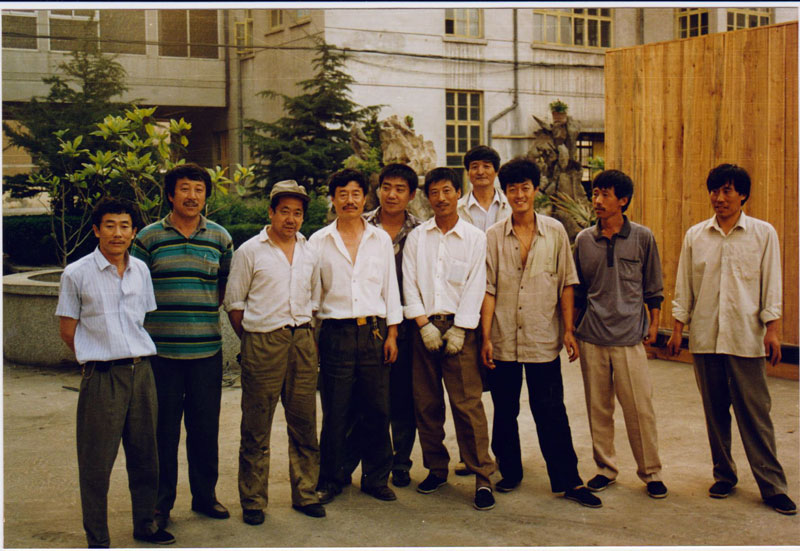
| Jau Quin and Carol | Phil Bewley | Dave Spensley and Carol | Ms Liu, Li Han Bo, Dir Sun, Mr Chang | Number 9 Assembly Team | Dave, PhilB, Phil H and drivers |
- Phil Bewley – Project Assistant. Stayed for around 2 years.
- David Spensley – Lead Fitter. Came out to China for several months at a time to supervise the assembly of each oven. He became a real favourite of the Chinese staff and was always good for a joke as well as his care and attention to the training and guidance of the workers.
- Jau Jie ( Carol ) - Our translator, and someone who stood by us pretty much twelve hours a day to make sure we got what we wanted and didn’t get into too much trouble
- Joe McInerny – Lead Electrician. Similar to Dave
- Li Han Bo – Office manager for LFTC
- Mr Yang – Lead Engineer working for APV Baker in China
- Jau Quin - Lead Chinese worker
- Mr Sun - Number 9 Factory Director
- Miss Liu – Number 9 Factory lead Engineer
- Mr Chang – Lead negotiator with LFTC
- Mr Twee – Mr fix it with LFTC
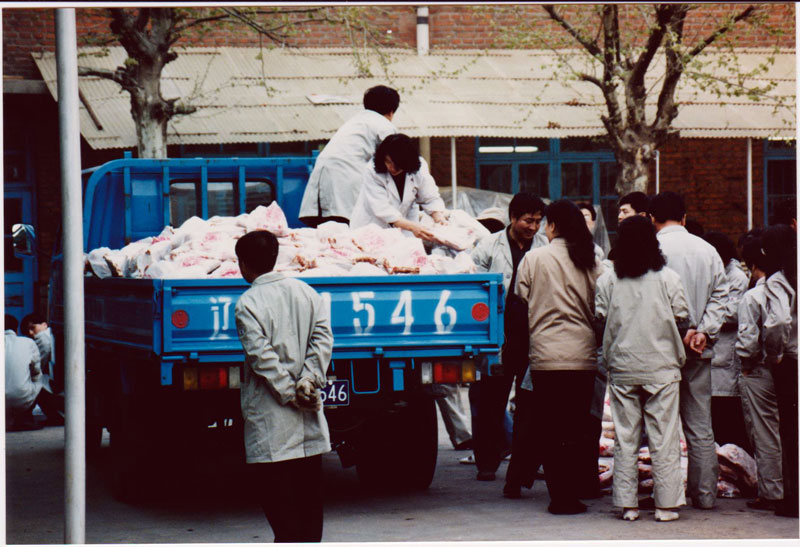 Reading back the Set up section above, this doesn’t sound
so daunting, so I felt that at this point I should record a few of
my personal memories as this may help describe the environment that
we were working in and hence some of the challenges we met.
Reading back the Set up section above, this doesn’t sound
so daunting, so I felt that at this point I should record a few of
my personal memories as this may help describe the environment that
we were working in and hence some of the challenges we met.
In 1994 it was not possible to fly directly to Beijing as visas were not obtainable in London, so we all flew to Hong Kong. A quick glance at the map will show a huge loop and about 24 hours of travelling to get to Dalian. As a smoker at the time, I eagerly got a seat down at the back and waited for my first trip to Asia. About 15 minutes after take-off and that little red light went out which signalled the filling of the rear half of the plane with cigarette smoke much to the disgust of the passengers who were sitting just in front of us – how times have changed ! Having been plied with many of those miniature bottles of whisky by a very understanding stewardess, and smoking myself half to death, I managed to snatch maybe an hours sleep during the night flight to Hong Kong. Arriving in Hong Kong for the first time with a crick in your neck and a hangover is not to be recommended, and the approach to the old Kai Tak airport which entailed a Jumbo 747 flying down a valley at such a low altitude that you could literally see in to people’s apartment windows soon focussed the mind. Having woken up from sheer fright during the approach,
I managed to get to the APV Baker office, which was to assist in my VISA application. Later that morning I bailed it to what I thought was a spectacular hotel, The Royal Pacific Towers, and crashed. Awaking mid-afternoon, I ventured out on the streets, and the sights, sounds and smells of Hong Kong were an overload on the senses. Even today the city amazes at every turn, but in 1994, the array of street food, small barrows being pushed on the pavements, and thousands of people at every turn was truly a new experience for a young Engineer. I liked Hong Kong – it was late October, it was 25C, and best of all I found an English pub just across from the hotel called the White Cross Inn which sold London Pride.
A couple of days later and armed with my new VISA stamp for China I headed back to the airport for the 3 1⁄2 hour flight North to Dalian. As we came into Dalian on the 1st November 1994 – (a date fixed in my mind forever) - my visit to Asia took a new tack. Where were the gleaming towers? Where were the bright red taxis ? Where was the sun ? As we taxied up to the Dalian terminal a short list of eternal memories were given to me:-
- I was given a souvenir from the airline to mark the flight – it seemed at the time that is was a token to show that you had been brave enough to take a Chinese airline ( they used to crash quite a few in those days ) and that they were glad they had made it to the destination in one piece.
- The Hong Kong sun I had left only 3 1⁄2 hours earlier had been replaced with snow which was blowing almost horizontally across the apron.
- There were soldiers on the apron ready to greet us and they were wearing thick green quilted long coats to protect them from the cold along with a matching green hat with ear flaps.
- The same soldiers were leaning at a not inconsiderable angle to prevent being blown away.
What had I done? Why could we not manufacture ovens in Hong Kong? There were no pontoons to protect from the cold, and having left Hong Kong in 25C, I was not really prepared for the walk across the apron to the terminal. A quick dash with my bag soon saw me at the door pretty much first and as I entered I had a sudden bout of intense fear. There were no English signs, just Chinese characters and arrows. Quickly adjusting my position to 3rd or 4th, I followed the crowd and then it struck me, I could not read anything, I could not speak anything, I had no money, I didn’t know my hotel and even if I did I could get there …. If Li Han Bo wasn’t there to meet me I was in big trouble. Having gone through the normal formalities which in those days took forever, I was happy to see a board with my name on it. The spelling was incorrect, but hey it was good enough for me.
Of course over the three years of working in Dalian I had far too many memories for this short article, maybe I will get around to writing a book one day. But to serve as an example of the daily challenges I met, I will recount just two fairly typical stories to give you a small insight to life in China in 1994.
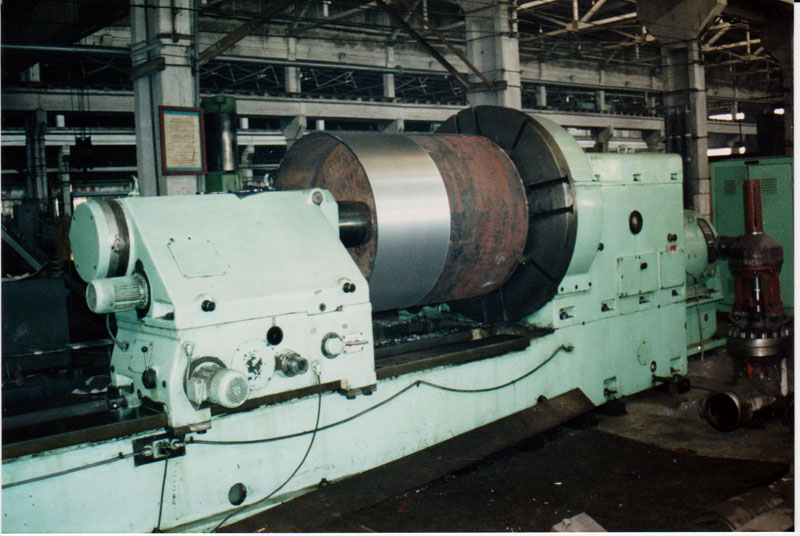
OK – so let’s be clear, the toilet was not nuclear, merely situated in the Nuclear 254 Factory. The 254 guys thought that they were capable of making the two oven drums we required. For those of you not familiar with an oven, these are two large steel drums that are first fabricated from rolled steel and then turned on a lathe to a precise diameter including a tapered surface to assist the oven band in tracking trough the oven.
 |
 |
 |
 |
||
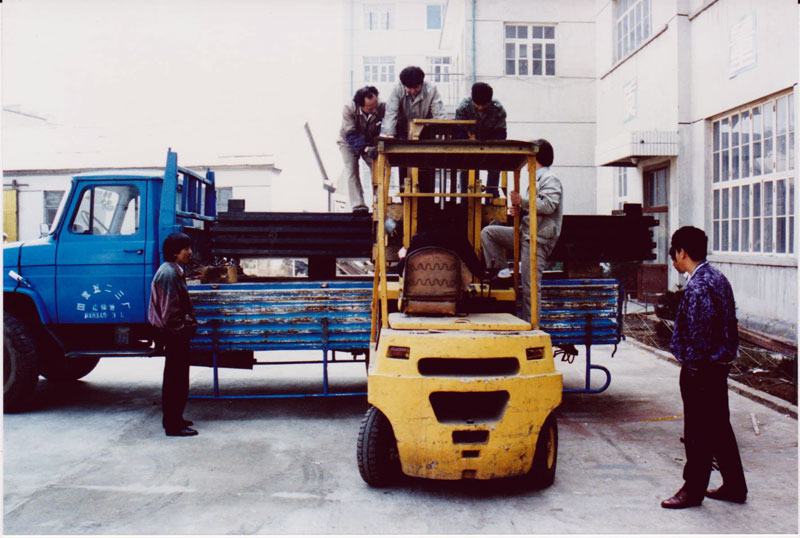
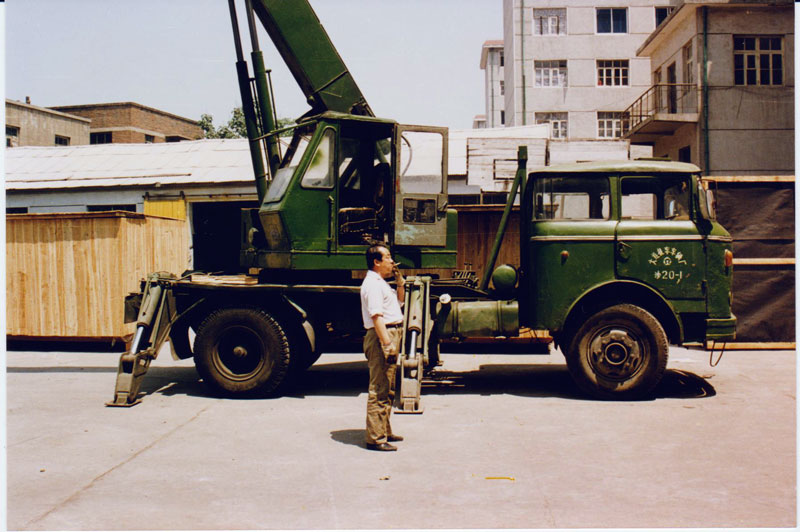
| Turning Oven Drum | Offloading was sometimes difficult... | Working with the latest equipment | Packing by hand |
We arrived at around 9.30am and were escorted to the special Westerners Meeting Room. This was a common occurrence and entailed sitting in a cold room on hard wooden chairs spaced so far apart that any meaningful conversation was difficult. We were then served tea and compulsory cigarettes whilst the factory director tried to impress us with his well versed presentation of numbers and facts about how great his factory was. To give you a feel of the 254 factory, they had around 25,000 employees, their own rail system, buses, shops, a hospital, a school and their own apartments for the workers… basically everything you needed to live, almost a small town in it’s own right. Oh and their own port as well. The director was not paid much more than the workers in base salary terms, but of course had the under table rewards of being provided with a car, private apartment and an expenses account.
Following tea it was decided that we were so close to lunch that we should have that prior to a factory visit. Lunch meant an array of expensive and often spectacularly unusual dishes, piled so high that it was impossible to even get close to finishing the food. Nothing was wasted however, as the directors salted away doggy bags for their families … another of the benefits of being towards the top. Meals were often accompanied by copious quantities of “Bai Jiu” (pronounced by joe ) a 40% liquor made from sweet corn, wheat and sorghum. It is evil stuff and it is fair to say that over the three years I became quite hardened to it.
Then, in a more relaxed state, it was off to the factory by shuttle bus. Outside it was around – 20C (yes minus 20C) and inside the factory it wasn’t much warmer. We wandered around several large workshops displaying some of the largest machines I had ever seen, and then finally to the lathe we required for the drums we wanted to produce. Excellent! It was at this time that my stomach had started to rumble, and I realised that something in the lunch has disagreed with me. I stuck it out for a couple of minutes more, but soon realised that I would need a toilet pretty soon. I informed Li Han Bo, to which the reply came back – no problem, we will take the shuttle bus back to the Westerners meeting room where there was a clean toilet. It was about a 15 minute drive back and there was no way I could make it. I pleaded again, and let her know that I now had only a minute or two before disaster. The director looked worried and mumbled something to a worker, who promptly took me by the hand a led me to the end of the workshop and through a heavy green curtain to the toilet.
Standing on the other side, I looked around with dismay as there were no toilets, just some sections of short concrete wall sticking out from the opposite side of the room. Time was not on my side, and upon investigation I found that these were the toilets … a 1ft square dry trough ran under the walls and judging by it’s contents, this was the toilet. Not to smelly as everything was frozen. I now only had seconds to spare, so there was no time for niceties. As my centre of gravity is not the same as an Asia person, I always found using a squatting technique a little difficult, but these toilets were not bad in that I could hang on to the top of the wall in front. During proceedings, I noticed that some of the Chinese workers had taken a great interest in this Western guy using their toilet, and a small crowd had gathered at the door to watch.
Upon finishing off, I was glad that I had heeded the advice from Li Han Bo and stuffed some toilet paper in my pocket, as Chinese toilets seem never to have this small item available, but having hung on to the wall for a good two minutes my hand had now frozen in to a cup shape and I could not get it into my pocket. The worker who had first escorted me to the room saw this and took pity on me, and with a wry smile of understanding presented me with several sheets of newspaper and beckoned his workmates away to give a little privacy.
Lesson learned …. If it is -20C, get the toilet paper out of your pocket before you squat.
The story of the Pen and Pussy
 A far shorter lesson in the problems of translation, culture and misunderstanding.
After several months, I was starting to get a smattering of Chinese which I wanted to use at every opportunity. You must bear in mind that Chinese is a tonal language so that each phonetic sound has different meanings depending upon the tone in which you say it. One morning I entered the office to find Li Han Bo sitting behind her desk using a new pen. It was a nice Parker and obviously a gift from some admirer. I was standing in front of her, so muttered “wo xi huan ni de bi” ( wo she wan knee de bee - I like your pen ) but unfortunately I got the tone of “pen” wrong and she started to cry, stood up and walked out of the office – refusing to talk to me for about two days. I asked my Engineer Mr Yang what I had done wrong, and when he explained that I had told her I liked her pussy, her emotional outburst became understandable.
Lesson learned – always take care with your tones, especially when talking about pens.
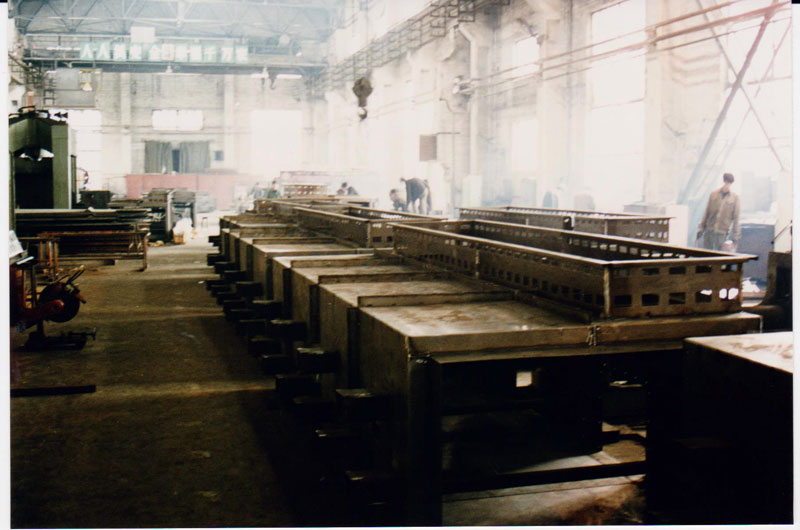
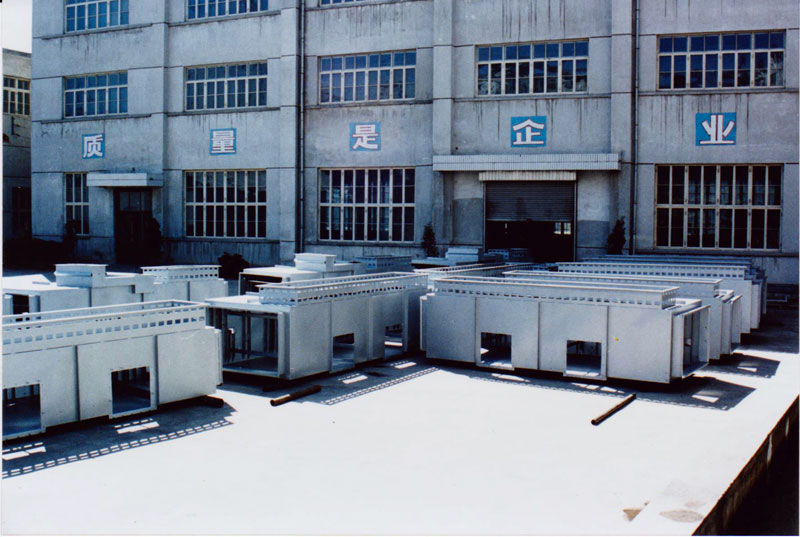
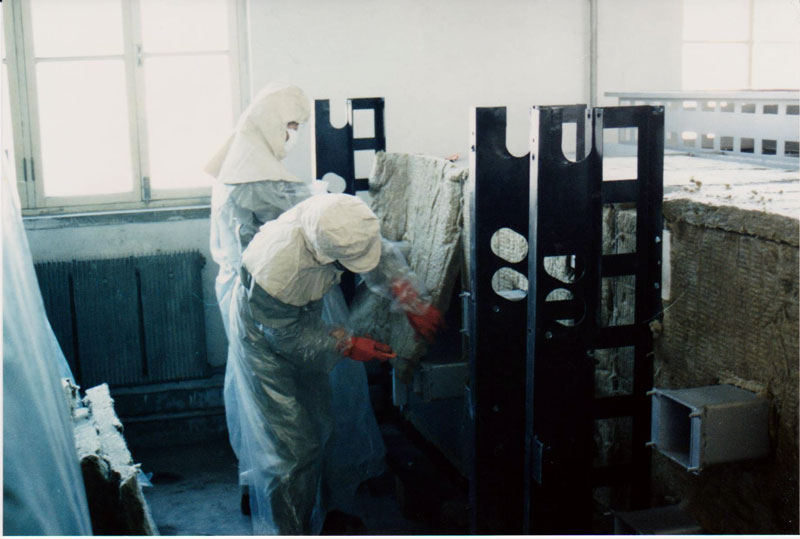
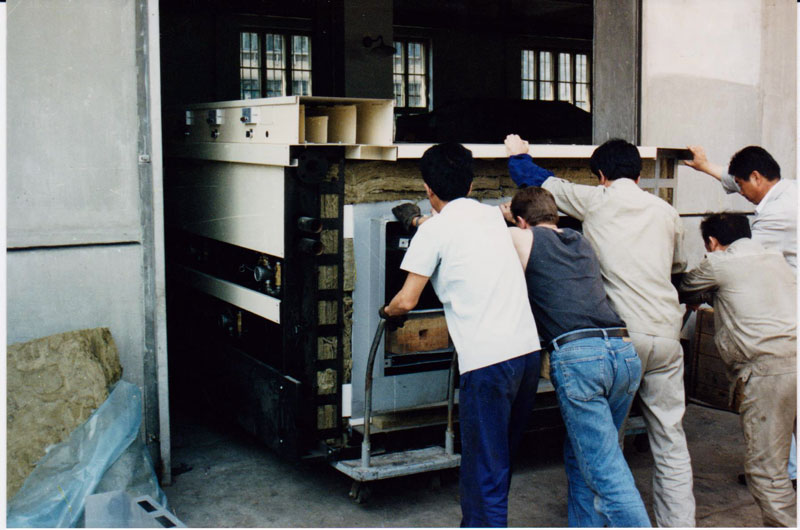
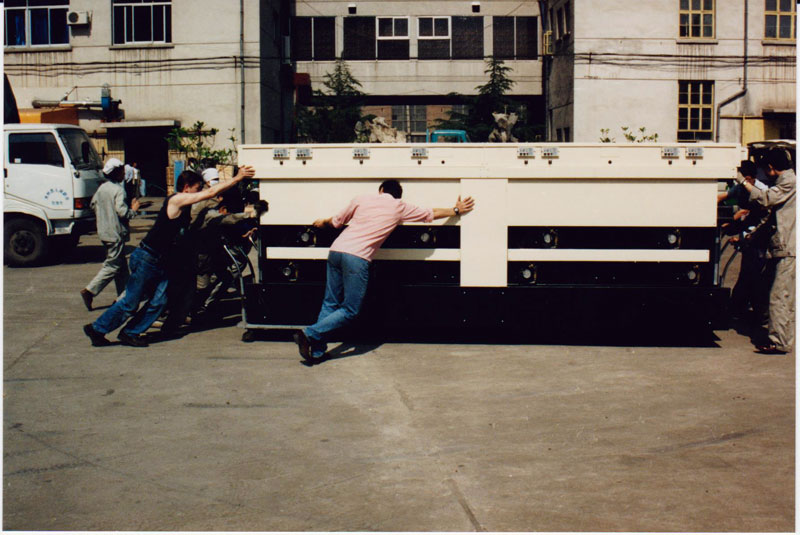
Our first oven was a 70m long 688 style for United Biscuits. The fabrications were completed in several factories but the main modules were made in HonChi Factory quite close by to Number 9 Factory. Also a large state run place, in some of the photos you can see the modules being made. The smaller parts were made in factories too numerous for me to remember, but the oven drums were eventually made in the notorious Nuclear 254 Factory. As an indication of how special foreign business was in 1994, the factory director had a Western style toilet installed in the factory the very next week to avoid another occurrence. You can see one of the drums being turned.
 |
 |
 |
 |
 |
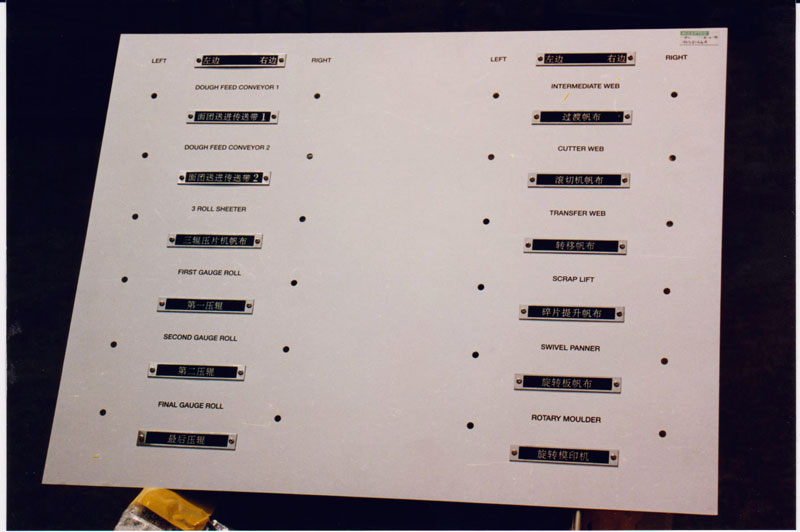 |
| Oven modules at HonChi factory | Oven modules at Number 9 factory | Insulating was not a favourite job | Number 9 was a close fit | Dave & Phil lend a hand | Translation was often fun |
Assembly was completed in Number 9 Factory, which was small to say the least, and getting the modules in and out of the bay took some very inventive ways for lifting, rolling or otherwise persuading the modules to move where we wanted them to go.
Generally the ovens looked pretty good and worked well, although I admit the paint quality was not as good as we hoped it to be. In the early 90’s it was very difficult to get good quality paint and even harder to find someone who knew how to apply it. I think it would be fair to say the ovens were functionally sound but cosmetically lacking.
All in all, I had a wonderful time working in China for the three years up until the Japanese banking crisis in 1997 when our business took a dive and we decided to shut up shop. In total we made 8 ovens of various sizes and styles.
My thanks go out to all involved for creating some very happy memories and giving me a base in Chinese factory experience. Since leaving APV Baker in 1997, I did some consulting work for a few years and then returned to China in 2002. I worked and lived there full time running 2 different factories until I decided to take early retirement last year. I now live in Thailand with my Chinese wife Michelle who I met in 1995 during my time in Dalian.
PHIL HARNETT - SEPTEMBER 2015
All content © the Website Authors unless stated otherwise.